
Audio is in Gaelic, text is in English.
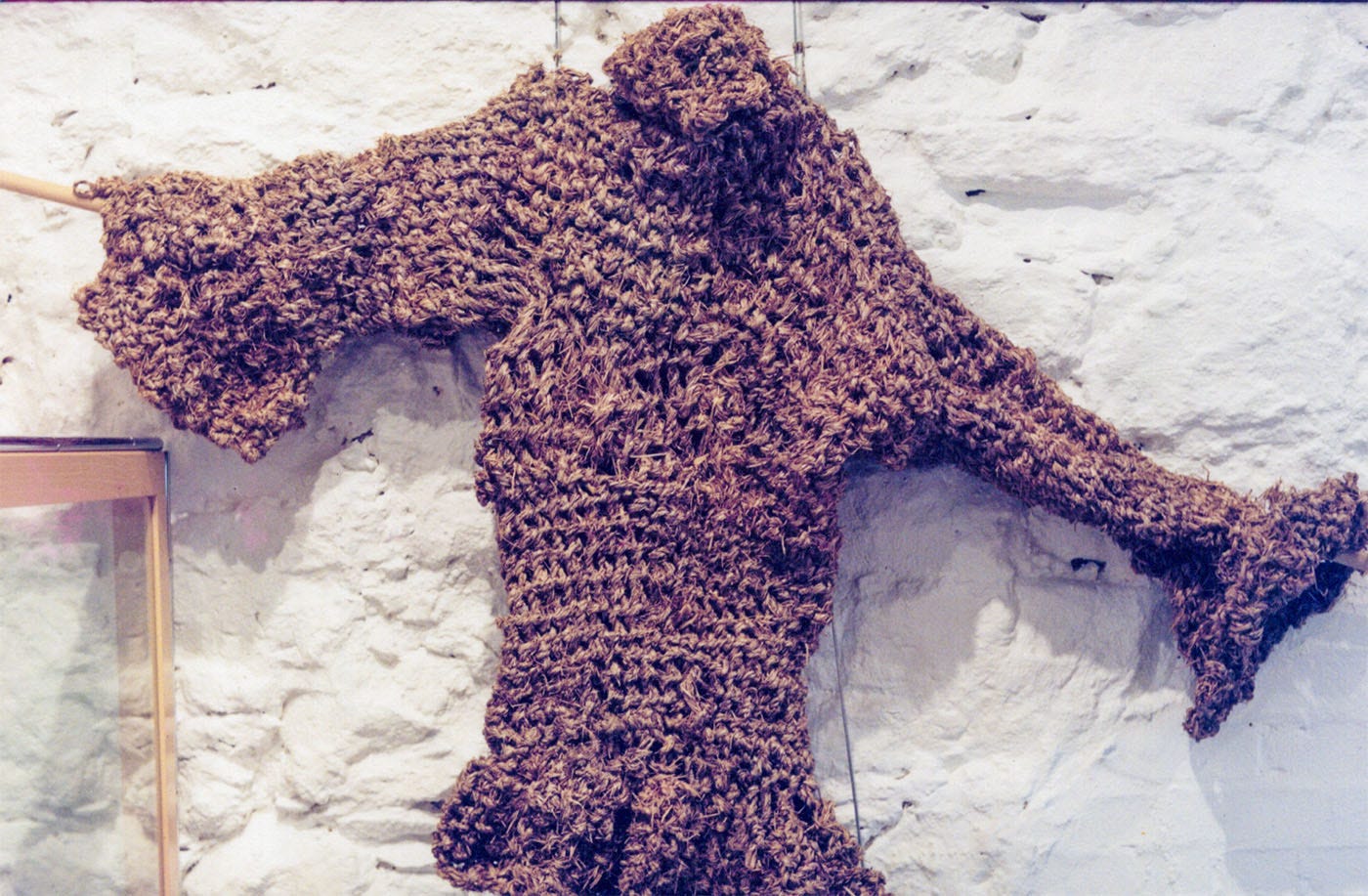
Angus MacPhee was an artist, weaving objects out of grass, wool and beech leaves. His work is moving, intricate, connected to the place he came from. Horse collars. Pouches for sowing. Ropes.
Born in Iochdar, South Uist, he was in the Lovat Scouts as a young man, stationed in the Faroe Islands, where mental illness became increasingly debilitating. He spent most of his life, about fifty years, in Craig Dunain Mental Hospital. He died in 1997 at the age of 81.
As a young man in South Uist, he loved horses. He would make harnesses for horses out of marram grass when he was young. He always loved horses, people said.
I still remember clearly when I found one of his pieces in the grounds of the hospital. We were filming a short documentary piece about him and were talking to people who knew him at Craig Dunain.
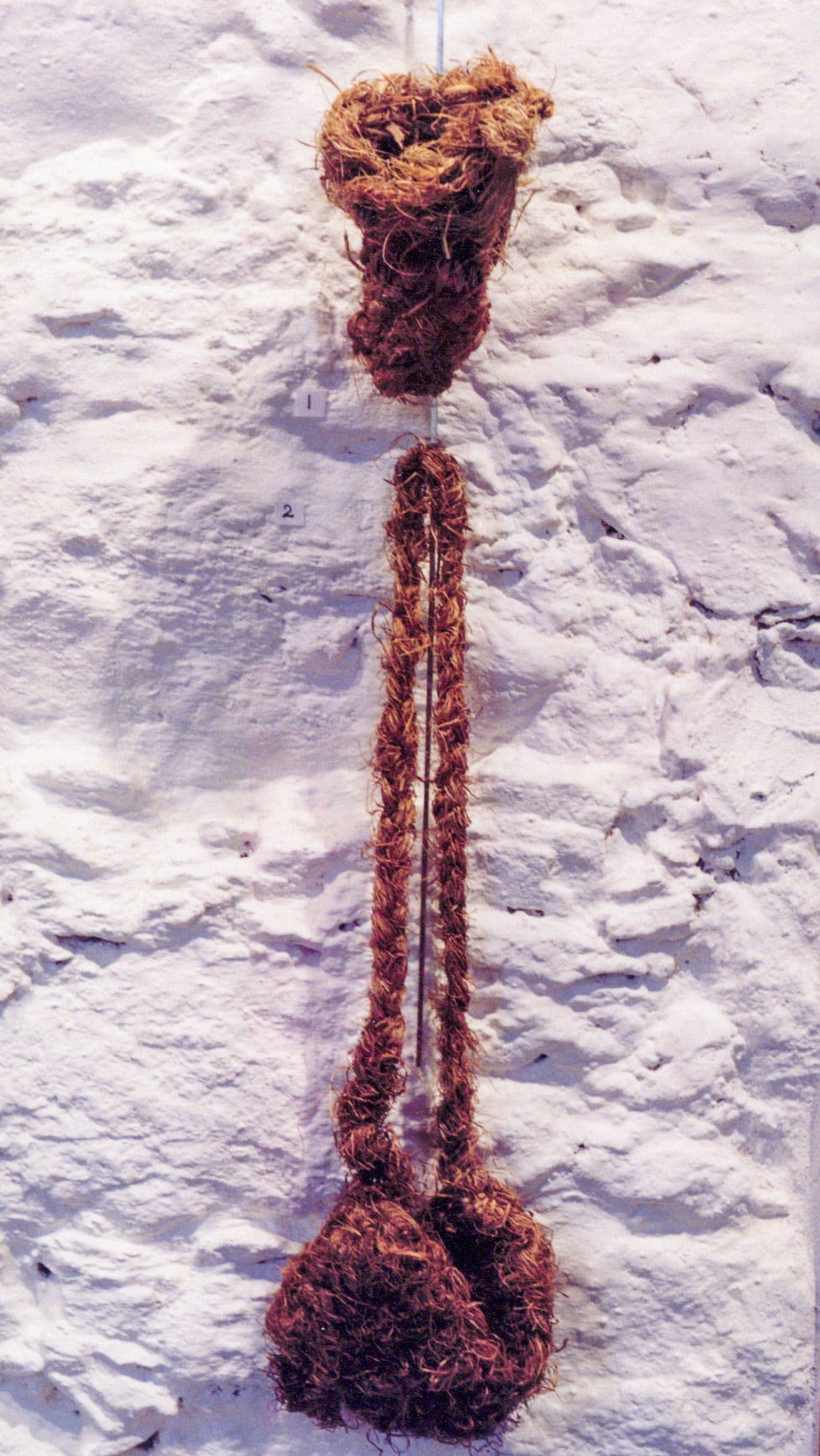
It was covered by leaves and earth, they fell off it as soon as it was moved. The dust of leaves losing purchase and slipping to the ground, And then, a rope. About a metre, woven from grass.
We started looking in earnest in the long grass then and the pieces started to appear. He used what he found to hand, grass, wool, beech leaves. It is a long time now, but they made a certain sound as they were unearthed.
When he was a young man, he signed up and served in the Lovat Scouts. He was posted to the Faroe Islands, and it was there that his schizophrenia started to reveal itself. It led him to becoming silent, with some saying he didn’t speak for decades, except possibly to some close friends in the hospital in Gaelic.
The art therapist Joyce Laing was central in bringing his work to light. She was researching artists in a medical setting with the playwright Tom McGrath when she met MacPhee. She framed art found in this setting as a neglected creative practice. Joyce Laing wrote a book about Angus called ‘Weaver of Grass.’
Laing defined Art Extraordinary as work that:
...possesses that powerful quality which impinges itself on the memory, for nothing quite like it will have been seen before. It is arresting.
Laing wrote that every day, whatever the weather, Angus would make things out of grass.
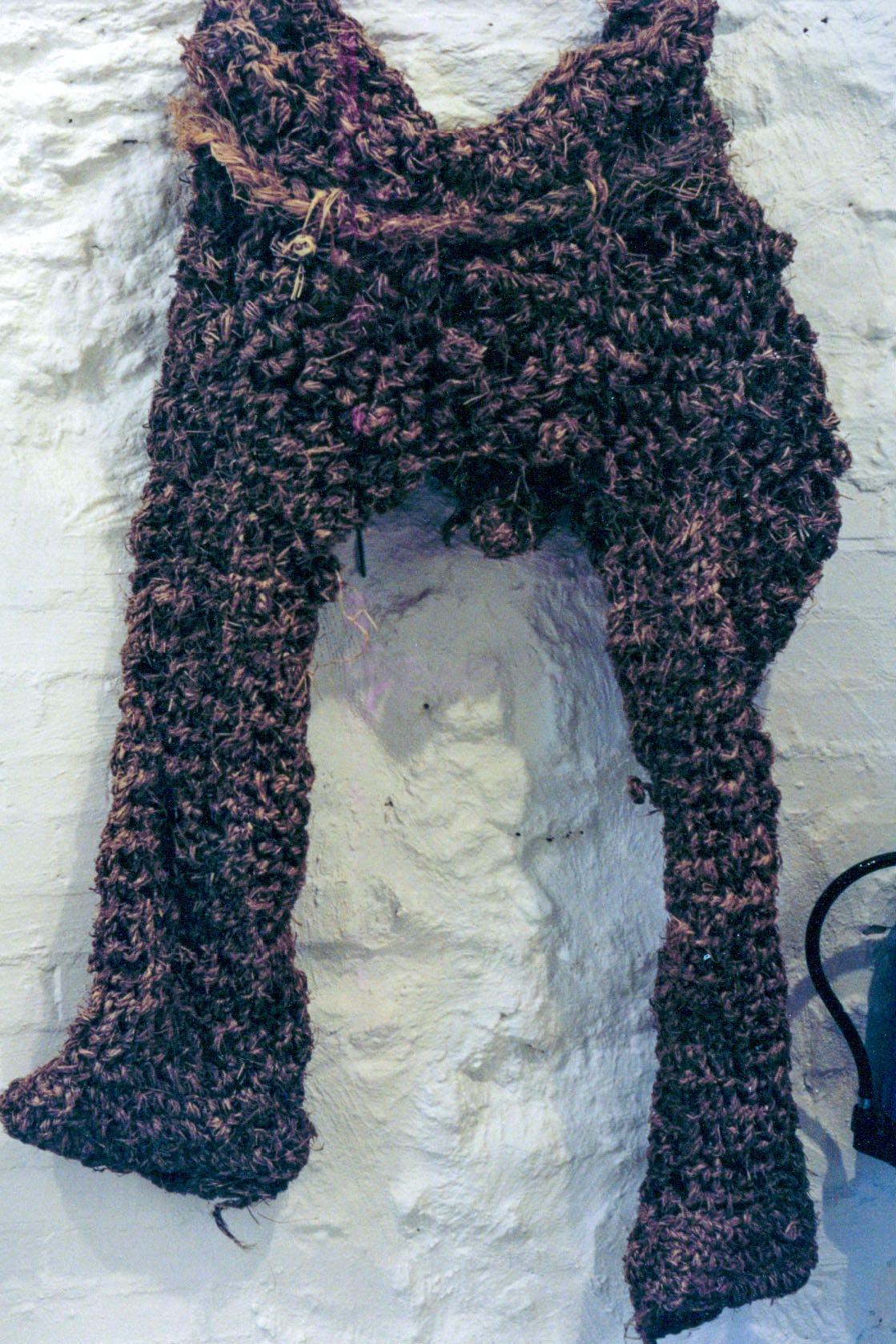
Once Angus had fashioned a length of plaited grass rope, usually about two metres long, he would commence on another and only when he had made sufficient of these to meet the needs of the garment in mind, would he begin to work on the actual garment. According to the nursing staff, he never possessed any form of implement to assist his creations, using only his fingers to weave and graft his lengths of rope into the shape of a coat, or trousers, or boots. (Laing, 2000).
Laing said the number of items was "immense" – coats, jackets, trousers, gloves, boots, waders, hats, there was even a lost swallow-tailed coat.
There were hats of such variety to make a milliner die for; caps with a peaked front in the style of a police hat; caps that had earflaps, fit for an arctic explorer and the unforgettable first time I met Angus when he was wearing a grass cap which had a smart peak to the front and fitted his head perfectly, while the crown had worn a little thin. (Laing, 2000)
Some use the term ‘Outsider Art’ for art which was made by people who were self-taught, outside the mainstream art world. I prefer the term used in Scotland for this kind of art - ‘Art Extraordinary’.
‘Outsider Art’ was coined by Roger Cardinal as the English version of the term ‘Art Brut’ - which Jean Dubuffet wrote about in a manifesto-essay in 1949 called “L’Art brut préféré aux Arts Culturels”. Dubuffet collected, classified, and exhibited Art Brut—creating a new canon. This is from that essay:
We mean by this works executed by people untouched by artistic culture, in whom imitation—unlike what occurs among intellectuals—plays little or no part, so that their authors derive everything (subjects, choice of materials, means of transposition, rhythms, ways of writing, etc.) from their own resources rather than from the clichés of classical art or fashionable art.
The term is debated nowadays and the edges of meaning eroded from it. If an artist who is called as an outsider artist has an exhibition of their work in a gallery, what does the term mean? By the 1990s and 2000s, Cardinal himself said there were problems with the term. Other art critics such as Foster and Pollock discussed the notion of being ‘outside’ as a fiction.
Foster said that there is no simple outside to culture, no position of purity from which to oppose it. (The Return of the Real, 1996) He says that it is a myth that people can create art completely free of cultural influence.
The German artist Joseph Beuys used to say that everyone is an artist, that the impulse to make art is part of the human condition.
The artist Will Maclean has also builds on objects with a tie to work, to the sea. In a conversation with Sandy Moffat, he said that “Often… the narrative reveals itself through the found object or the process of making” and that “The creative process is still the same whatever the media.”
There are multiple examples in the material culture of an area like the Scottish Highlands which show how far cultural transmission of objects and techniques can reach. One example is Barvasware, from the Isle of Lewis. It is earthenware which was copied from mass-produced Staffordshire and Clyde pottery tableware from the late 19th century. So yes, no position of purity.
I wrote a play called ‘I was a Beautiful Day’ at the Traverse Theatre in Edinburgh in 2005 which was initially inspired by Angus MacPhee’s story and finding his work in the grounds of the hospital. The main character in the play, however, made maps. I was always taken by Tim Robinson’s maps of the Aran Isles and Connemara in Ireland, walking the land and finding stories connected to places.
I come from a place which similarly is rich in placenames and I thought that the character could be doing this, making a map of the island he came from but on a scale of one-to-one to be able to represent these stories. I’ve since found the term for this was creating ‘deep maps’, with levels of information and story.
MacPhee’s work is a deep map. His world was physically confined to the grounds of the hospital. But nothing held back his imagination and the gift of his hands.
Many thanks to Norman Macleod, Taigh Chearsabhagh, for his help sourcing photographs. There are two other main places to see Angus MacPhee’s work online - the collections of Am Baile and Glasgow Life.
MacPhee’s work has inspired many artists. The Mackenzie Sisters recorded a song ‘Fighe le Feur - Weaving with Grass’ (Spotify Link). Horse and Bamboo Theatre Company did a show about him. Singer Donnie Munro recorded a song on his album Fields of the Young called “Weaver of Grass.“ (Spotify link.) Poet Chrys Salt has written a number of poems about Angus MacPhee. Roger Hutcheson wrote a book about McPhee called - The Silent Weaver: The Extraordinary Life and Work of Angus MacPhee (Published by Birlinn in 2011.)
OTHER WEAVINGS
If you are interested in Angus’ art, you might also get a lot out of the work of these other artists:
Ruth Asawa - She makes incredible spiral sculptures, woven out of wire. In Toluca, Mexico, she came across a wire basket in a market and learnt the technique. She was a farm worker, so knew wire, fencing, baling wire. Here is a video on the Museum of Modern Art Channel about Ruth Asawa’s life and work.
Nnena Kalu - Here is a video of artist Nnena Kalu creating work. It’s amazing to see how she so fluently works with materials, weaving and binding them together. She won the Turner Prize (2025).
Here is a recording on Tobar an Dualchais/Kist o’ Riches about making a rope from heather - (Siomain-fraoich.)
FURTHER READING
Bateman, M. and Purser, J. (2020) Window to the West: Culture and Environment in the Scottish Gàidhealtachd. Sleat: Clò Ostaig, Sabhal Mòr Ostaig. A PDF of Window to the West is available on the Sabhal Mòr Ostaig Website.
Foster, H. (1996) The Return of the Real: The Avant-Garde at the End of the Century. Cambridge, MA: MIT Press.
Laing, J. (2000) Angus McPhee: Weaver of Grass. Lochmaddy: Taigh Chearsabhagh Trust.
Maclean, W. and Moffat, S. (2011) ‘Will Maclean in conversation with Sandy Moffat’, in Will Maclean: Collected Works 1970–2010. London: The Fleming-Wyfold Art Foundation.


