
Audio is in Gaelic, Text is in English.
When the band Radiohead did a tour in 2025, a recording of Gaelic psalm singing was part of the pre-show playlist. Other musicians like Craig Armstrong and Martyn Bennett have also explored it in their music.
It moves and fascinates people. How did this style of singing begin? And how does it work musically?
Musician Calum Martin has a particular interest in Gaelic psalm singing, its origins and how it has evolved.
In our conversation, he talks about how the “long tunes” in the Scottish Psalter were Gaelicised and adapted and how he believes it evolved in the Gaelic speaking community.
He also touches on similarities with singing in the Coptic Ethiopian Church (another style of heterophonic music). This is where two or more performers play or sing the same melody simultaneously, but each person adds their own slight variations. Here is a link to a YouTube video of music of the Egyptian Coptic Church.
Calum also talks of the time he collaborated with singers from Alabama, and the theory popularised by Musicologist and Yale University Professor Willie Ruff, that Gaelic psalmody influenced African America church music.
What started Ruff down this path was his friend, the musician Dizzy Gillespie, saying that some African American congregations in the Deep South sang hymns in Gaelic. I link to a Vimeo documentary about the subject called “A Conjoining of Ancient Song” below. It’s fascinating and moving. There’s also some footage of a Muscogee (Creek) congregation lining-out, which Ruff argued was brought into their culture in a similar way.
It should be noted that this theory is disputed, with other academics such as Terry Miller arguing that the practice of 'lining out' in both Hebridean and African-American traditions is a vestige of an older English practice that has long since disappeared in England.
Michael Newton’s writing on the socio-linguistic profile of Cape Fear Gaeldom is really worth reading if you are interested in this area. Michael writes :
In another account from 1829, the town of Fayetteville was said to be such a strong bastion of Gaelic speech that even public servants needed to be able to speak the language (and presumably read and write it); “The number of these Highlanders and their descendants, who still retain almost exclusively their native language, is so considerable, that a clerk who understands Gaelic, forms a necessary part of the Post-office establishment.”
Calum’s parents were living in Glasgow when he was born, and the family returned home when he was four years old, to Calanais on the Isle of Lewis.
It was at that young age that he went to church with his grandfather and heard this particular form of worship. His grandfather was a precentor in the congregation at Calanais.
As the psalms are sung unaccompanied, a precentor stands at the front of the congregation, they give the starting pitch and lead the congregation in vocal harmony. The word “precentor” is from the Latin and means “the one who sings before.”
Here is a short example of Gaelic psalm singing which Calum recorded, so you can hear this particular style of unaccompanied singing - Psalm 133, recorded in Stornoway.
Here are edited extracts of Calum’s answers, translated from Gaelic.
CALUM MARTIN ON GAELIC PSALM SINGING
My grandfather was taking me to the Gaelic services, and at that time, it is little wonder it was soaking into me, because at the age of four I could not yet read Gaelic. This was before I went to school… I was hearing the psalms, and it was little wonder it was just entered into my mind.
…I asked my grandfather — do you remember a different way from how we do it now? — and he said, No, not on this island; the way we do it today is the way they always did it. But something happened, I would say, around Nineteen Hundred.
As for what kind of style this was, what was different about it from English — because the remarkable thing is, all the tunes we have in Gaelic are taken from the English ones. Every single one of them is in the Psalter.
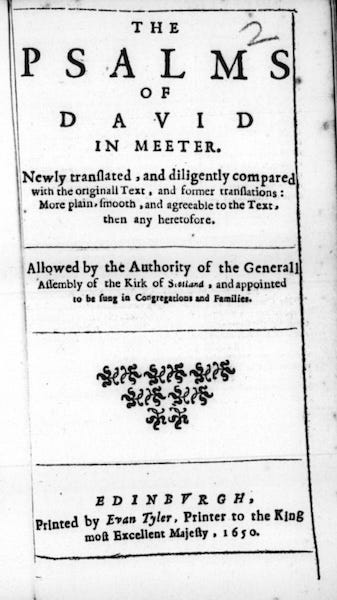
When the Gaelic psalms were first composed, they used what were called the long tunes, and there were only six of them. They were sung in a way where those who oversaw the music in the church wanted to keep things regularised.
Before that, it was what they called “lining out”, and that still happens in America in certain places, though they use hymns rather than psalms.
Well, at first there were only six of them — six tunes, as I said, going back many years, hundreds of years. It came out of those six tunes. Only two or three of them are used today.
Wait now — “Stilt,” that one isn’t used anymore. Well, that was a tune from that time. “French” — that one is still used. “Old London” — yes, well, that one is gone, not used anymore. It’s “New London” now.
The psalms are composed in what is called ballad metre — now, we are all familiar with that today — eight six eight six — ‘The Lord’s my shepherd, I’ll not want, He makes me down to lie, in pastures green He leadeth me, the quiet waters by.’ That is common metre, and that is what is used today.
And the melodies we have in the psalms come from the soprano line.
So today, in the churches, four-part harmony — SATB, soprano, alto, tenor, bass — all those settings are in the church in what they would call the Scottish Psalter.
And there are many other things to think about — well, how did the congregations start using it?
At that time, in the villages, there was family worship, morning and evening, in every home. Even people who were not Christians at all would have it, and that is where we learned.
You know, people ask — where did you learn? Well, there would be a singing school — I remember the singing school… when I was a teenager, where we would learn the tunes at school. We didn’t have television then. So that is where all the lads would go on a Friday evening to learn the tunes. But it was in the family worship that most people learned.
The English-speaking churches would do it as a choir. What Gaelic singing is, is an old style, old tradition — Seann Nòs — that was brought into the church. It’s a tradition that we were able to bring into the church — that is what happened. The grace notes - everything - has been incorporated.
Many people ask - why is it that Catholics don’t do it? Well, the reason they don’t is that it was never part of their tradition. They relied heavily on choirs, and their worship was in Latin. They didn’t have Gaelic (in church) until the seventies, though they do have a great interest in the seann nòs tradition.
At that time, the people in the north had seann nòs in their very bones — so what happened? They…began adding a great many grace notes to everything.
A grace note is something you add to the main note. If you were doing it in English: da, da, da, da — those are four notes, plain four notes. But think now about the first one — the grace notes circling around it. What it is: there’s the acciaccatura, the appoggiatura — those are the technical names. There’s music in the thing. Simply notes that people feel.
So right now, in the psalms, there are what you might call signpost notes — that is what you have in Gaelic singing. But around those signpost notes, a great many grace notes are taking place….what the Gaels do - they add to it. They make it slow, slow, slow, and then they add the grace notes in.
There is something within us that wants to do it in the seann nòs style. Someone started it. Now, was it a minister who began it? Who knows?
But the thing is, Iain, this is going on throughout the world. Others will say, “Oh well, this is remarkably similar to the Ethiopian church, the Coptic Church.” People say, “Oh, perhaps Gaels went over there and they learnt from them.” But I would say — and this is very much my own view — that there is something called community singing going on in every place in the world.
So the way they would do grace notes over in Ethiopia would be a little different from the way we do it. But the style would be similar. That’s the thing — that’s my own view.
Two or three years ago now… I had a group for Gaelic psalm singing, and we went over to America and they came over to this island from Alabama, and they began to notice — this is the same way we sing, but they were doing it with hymns.
So right now, it is in English they are doing it over there, because it has been more than — I believe — two hundred years since people were doing it in Gaelic over in America.
Is this another subject altogether? We could go into it, and indeed — fifty thousand Gaels went over to America to the Cape Fear area in North Carolina. They had enslaved people - it was a terrible thing - and those enslaved people were being brought into the churches. But it was Gaelic that they were learning. They had the Gaelic, and they were learning the psalm singing style in the church, and after they were emancipated they left, and that tradition of theirs became blended together with other music.
When a group from India came over, we were doing something together (for a concert). They did their own thing, we did our own thing, and then we played one tune together.
And the interesting thing about the people from India is that the grace notes they do are a little different. Our grace notes are remarkably pentatonic — you know yourself, you have a sense of what it is when Gaelic people do their own grace notes.
Say you’re starting to sing something, whatever you’re doing, doing it slow, slow, slow, until eventually it’s as slow as anything. You feel, when you’re singing the thing, that you want to add a little to it, you know, you just want to feel something — something like the blues guitarists, you know, the way they do it, things like that. That’s really what the grace notes are. But it’s particularly in Gaelic, tied into the old tradition, the singing we do as old-style, purely secular old-style, you know.
For me, that’s one of the things that happened. It came about because of the simple way of worship we had in the church. There was nothing but the voices. There were no instruments or anything. You were then free, when you got a tune in your head, to add to it as you yourself felt, you know — and that’s what was wonderful about the Gaelic psalms. In a way, it shouldn’t work, because everyone is adding their own notes. You know, if you tried to do that with a piece of music it would make no sense, but when you do it in this remarkable way, it does.
Another interesting thing about that — a famous man came over from Germany, known as Joseph Mainzer, and he went around all of Scotland notating things, and we have it written down in notation — “French as sung in Sutherland,” “French as sung in Skye.” (Here is a link to an online version of Mainzer’s book - The Gaelic Psalm Tunes of Ross-Shire on the Internet Archive site.)
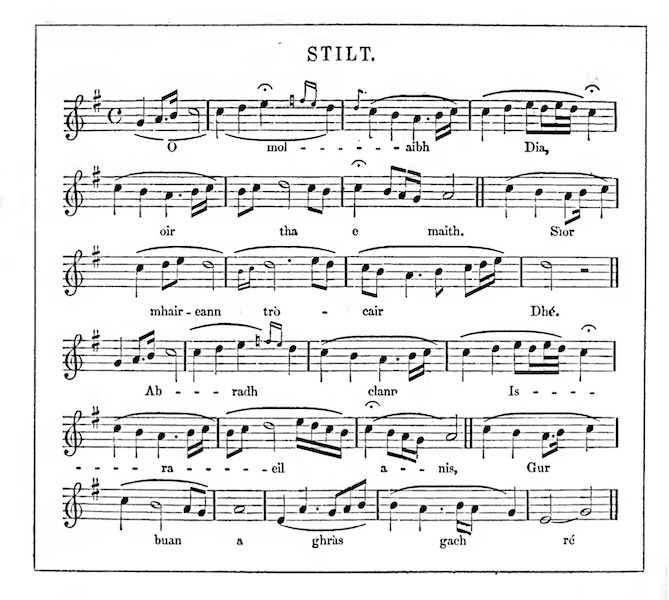
So he was going around the churches, and when you think about it, Iain, it’s very interesting. Say people on this island were learning “French” — say in the Point area, or “French” over on the West Side.
What was happening was that the congregations, after a while, were a little different from each other.
Perhaps Point was doing it a little more slowly, or perhaps Harris was doing it a little differently, but they were just learning it.
But you’d say to yourself, well, when they went to church, what happened? Well, they had learned it — someone would surely have said, “We’re going to learn “French”, and I believe people in the congregations who had a little musical knowledge — perhaps they held a singing school where they picked it up.
Well, “Let’s come together, we’re going to learn this in family worship, and perhaps we’ll spend two or three weeks doing it as family worship. Then we’ll all come to church and start doing it.”
So there would be a precentor, inevitably, who would know the tune. And then, after a while — as happens in many places — some of those who were singing had wonderful voices, and perhaps after two or three weeks, or maybe a month, those people would start, and the others would begin listening to them.
The interesting thing about it is that it was so suitable for every type of person. It was going so slowly that you could be singing it and perhaps learning it at the same time. And there were those with a good ear — they would pick it up very quickly — and the thing was going so slowly that even if you sang a wrong note, you wouldn’t notice it in the sound where there were hundreds of people.
But after a while, when you made a mistake, you’d say to yourself, “Oh, I must remember — next time we do this, that wasn’t the note I should have sung.” That’s the way I think, Iain, in my own mind, that it was learned.
Now, all the ones we have today — most of them, apart from the three or four that were made when they were doing the long tunes that were written down, where Joseph Mainzer came over and sat and notated — I’ve been looking at those notations that were made. There’s no connection whatsoever. It’s so different from the way we do it today.
Now, when you listen to that, and when you listen to “French” being sung in a congregation here on this island, you know it’s the same tune, but there are many differences between them, you know.
So that was one thing. The next thing — we have a book from 1935, or I think it may be 1932, where they started using new ones like “Moravia.” And the interesting thing about that is — I remember it in my own lifetime — when “Moravia” was introduced to the church, some of the old men didn’t like it at all. “Oh, this is too jolly,” they’d say. Well, all of those tunes today are part of our heritage.
Now, everyone thinks this started on this island? It did not. I’ve been speaking to people in the church asking where they think it began — because surely it had a beginning, where some minister or someone said, “We’re going to do this here in our own way. The people in the church in the south, if they want to keep going as they are, they can do that. But this is the way we’re going to start it here.”
And we’re going to sing the first two lines — the precentor will stand up, he’ll deliver the tune after leading through the first line. The congregation says, “Ah, we know what tune that is,” and by the end of the second line the tune is, as they say, established.
Then the third line is presented, the congregation does it, and that’s how it continues — four lines in each stanza, from each verse. I know that’s a long-winded explanation, Iain, but there are so many things connected to it that make it so special.
And the one other thing I’d say — at the end of the day, people will ask, “Would it work in English?” It would, but it wouldn’t be right. For me — I have heard it — some churches were doing it, the Presbyterian church, Free Presbyterians for example. I know they would do it in English at times. On special occasions, I think. Someone might correct me on that.
They would be singing this style in English, not in Gaelic. For me, it made no sense to me when I was saying to myself — most of the people who do it in English have Gaelic. Why are they not doing it in Gaelic?
There’s no doubt it can be done in English, but for me my ears are saying — the thing is woven so deeply into our language, you know, just the style itself, as you might say. If people over in India, or Ethiopia, were singing in the congregation, in the community, they would have their own distinctive sound. And that, for me, is what I think makes it so different, and why people today have such a great interest in it.
There isn’t a sound like it in the world when it’s done well. What’s so important to me, it’s so tied to our language and culture.
Thanks to Calum for his time and his deep knowledge on the subject, it’s much appreciated.
RESOURCES
Here is a documentary on Vimeo - “A Conjoining of Ancient Song” by Willie Ruff and Gretchen Berland. You can hear an example of lining out of a hymn at 1 min 38s. At 17 min and 39 you can hear lining out by the Muskogee (Creek) people.
Pròiseact Bàta nan Salm / The Psalm Boat Project - a blog by Dr Frances Wilkins, Senior Lecturer in Ethnomusicology at The Elphinstone Institute, University of Aberdeen, which explores contemporary spiritual singing practices of people living in the West Highlands and Western Isles of Scotland.
The Matheson Trust - Gaelic Psalm Chanting (With a Recording)
Michael Newton’s writing: A Socio-Linguistic Profile of Cape Fear Gaeldom on his Substack The Virtual Gael.
Free Church of Scotland Psalm Singing Resources - Includes Text of the 1650 Psalter.
Here is a link to the Thom Yorke Radiohead’s 2025 Pre-show Mix - the Gaelic psalm is number 31 on the list.
Thank you for reading.


